How to Forage for Mushrooms Safely: Your Ultimate Guide to Wild Harvesting Without Risks
To forage for mushrooms safely, start by educating yourself through books, apps, or guided tours to identify species accurately. Only pick mushrooms you’re 100% sure about, cross-reference with multiple sources, and avoid anything with white gills, red caps, or bulbous bases unless confirmed safe. Forage in clean areas away from roads or chemicals, use proper tools like a knife and basket, and harvest just what you need to leave the ecosystem intact. If in doubt, leave it out—better safe than sorry.
Why Dive into Mushroom Foraging?
Mushroom foraging draws people in for good reasons. It’s a way to connect with nature, get fresh air, and bring home free, flavorful ingredients that beat store-bought varieties. Think about the earthy taste of chanterelles in a pasta dish or morels sautéed with butter—they add a gourmet touch without the price tag. Plus, it’s exercise disguised as adventure, wandering through forests or fields.
But popularity has surged lately. With more folks interested in wild foods, social media buzzes with foraging tips and photos. This trend makes sense: it’s sustainable eating at its core, pulling from what’s around us. Yet, this rise also highlights why safety matters. Without proper knowledge, a fun outing can turn risky. That’s where understanding the basics comes in, building confidence step by step.
Foraging isn’t just about food; it’s educational too. You learn about ecosystems, how fungi support trees, and the cycle of growth after rains. It’s rewarding to spot a cluster of oysters on a log after a hike. And for families, it’s a shared activity that teaches respect for the wild.
The Real Dangers: What the Numbers Say About Mushroom Poisoning
No one wants to downplay the risks here. Mushroom poisoning happens more often than you might think, and the stats back that up. In the United States alone, over the last 18 years, poison control centers have logged about 133,700 cases of mushroom exposure, averaging around 7,428 per year. Most involve ingestion, and while many are mild, some lead to serious trouble.
Take amatoxin-containing mushrooms like the death cap—they’re behind a chunk of severe cases. Hospitalized patients who get quick treatment have a mortality rate of about 10%. In 2016, accidental poisonous mushroom ingestions led to roughly 1,328 emergency department visits and 100 hospitalizations. Globally, it’s a bigger issue; in some regions, mushroom poisoning accounts for up to 31.8% of foodborne outbreaks and 47.4% of related deaths from 2003 to 2017.
These numbers aren’t meant to scare you off—they’re a reminder to proceed with caution. Symptoms can range from stomach upset to liver failure, depending on the type. The key logic? Most incidents stem from misidentification. By focusing on education and verification, you slash those odds dramatically. Experts stress that with proper ID, foraging is as safe as any outdoor pursuit.
Gear Up: Essential Tools for Safe Foraging
Heading out without the right stuff is like baking without measuring cups—messy and unreliable. Start simple: a sturdy basket or mesh bag lets spores drop as you walk, helping future growth. Avoid plastic bags; they make mushrooms sweat and spoil.
A good knife is crucial. Use it to cut stems cleanly, leaving the base in the ground to avoid damaging the mycelium network below. Brushes help clean off dirt on-site, and a small trowel can dig up specimens for full inspection.
Don’t forget navigation tools—a GPS app or compass keeps you from getting lost in dense woods. Wear long pants and boots to dodge ticks or thorns. And pack a field guide or app on your phone for quick checks.
For comfort, bring water, snacks, and a first-aid kit. If you’re in bear country, noise-makers or spray add peace of mind. This setup isn’t overkill; it ensures you focus on the hunt, not mishaps.
Master Identification: Top Books and Apps to Get You Started
Identification is the heart of safe foraging. Jumping in without resources is risky, so lean on proven tools. Books offer depth; “Mushrooms Demystified” by David Arora is a classic, packed with photos and keys for North American species. It’s detailed yet approachable, perfect for building a foundation.
Another standout: “All That the Rain Promises and More” by David Arora again—it’s pocket-sized with humor and clear illustrations. For regional focus, “Mushrooms of the Northeast” by Teresa Marrone covers common finds with simple guides.
Apps bring tech to the table. Shroomify uses geo-location to suggest local mushrooms, while Book of Mushrooms acts as a digital assistant with photos and descriptions. Fungitron is Android-friendly for on-the-spot IDs.
Why these? They cross-reference features like cap shape, gill color, and spore prints. Apps often include community verification, adding layers of confidence. Combine a book with an app for the best results—books for study at home, apps for the field.
Beginner-Friendly Edibles: Start with These Safe Bets
For newcomers, stick to mushrooms with distinct traits that minimize mix-ups. Chanterelles top the list: golden, fruity-scented, with ridge-like gills. They’re hard to confuse and taste amazing grilled.
Morels are another winner—honeycomb caps on hollow stems, popping up in spring near dead elms. Oyster mushrooms grow on trees in shelf-like clusters, with a mild anise smell.
Hen of the woods (maitake) forms at oak bases, looking like ruffled feathers. Puffballs are round and white inside when young—slice to check for no gills.
Lion’s mane resembles a shaggy waterfall on logs, great for seafood-like dishes. These are popular because they’re widespread, tasty, and have few dangerous look-alikes. Always confirm with guides, but starting here builds skills without high stakes.
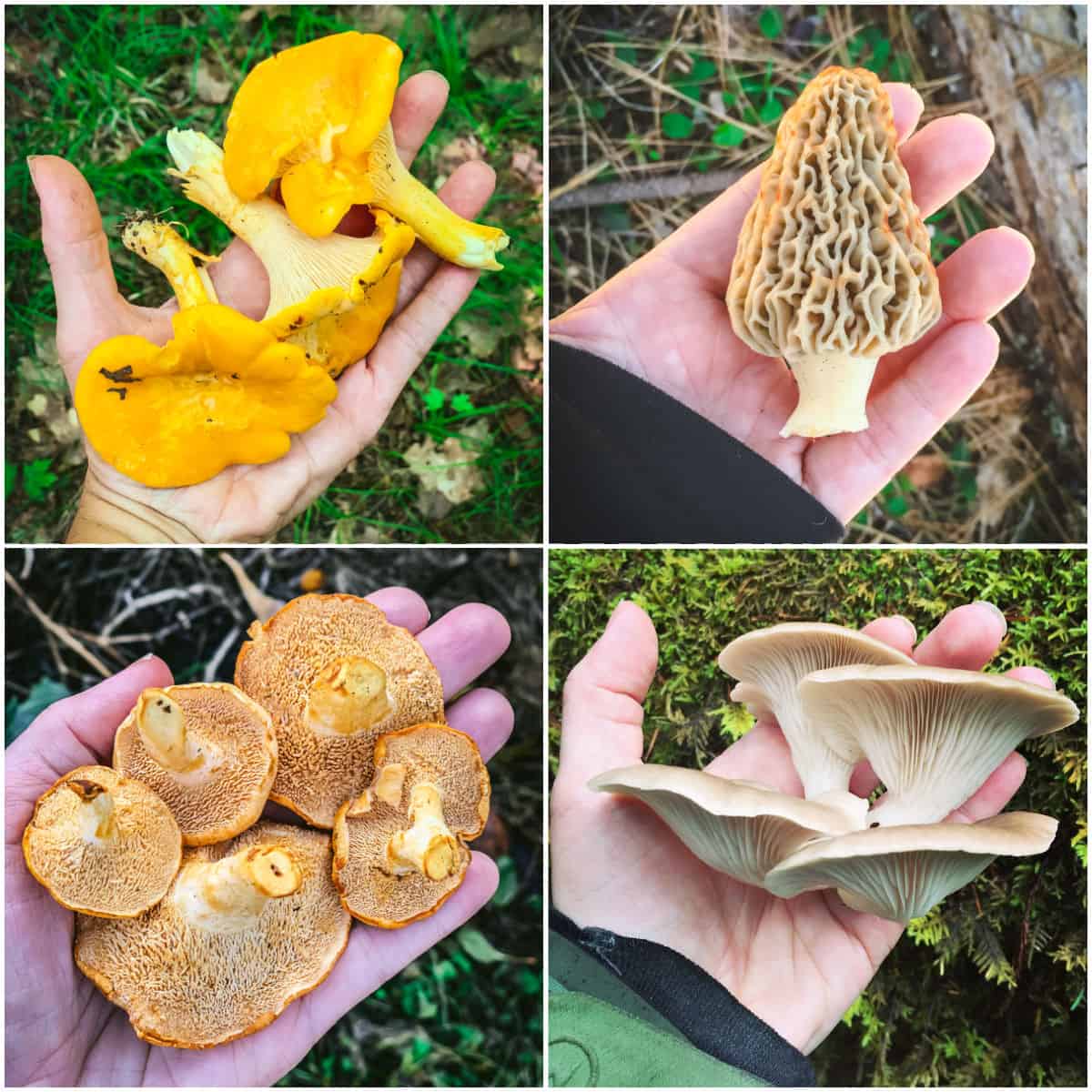
Various easy-to-identify edible mushrooms including chanterelles and morels.
Logic for these choices? They’re abundant in many areas, reducing frustration for beginners. Plus, their unique features make ID straightforward, lowering error risks.
Watch Out: Poisonous Mushrooms You Must Avoid
On the flip side, know the villains. The death cap (Amanita phalloides) is infamous—greenish cap, white gills, and a bulbous base with a skirt. It causes most fatalities, with toxins hitting the liver hard.
Destroying angel, another Amanita, looks innocent with all-white features but packs the same punch. False morels (Gyromitra) have brain-like caps and contain gyromitrin, a carcinogen.
Jack-o’-lantern mushrooms glow faintly and cluster like oysters but cause severe gut issues. Autumn skullcap is small and brown, loaded with amatoxins.
Why highlight these? They mimic edibles—death caps resemble paddies, false morels ape true ones. The pattern: many toxics have white gills or rings. Avoid anything matching that unless expert-confirmed.

The deadly death cap mushroom with its characteristic features.
Research shows about 50 of 5,000 mushroom species are poisonous to humans. Spotting differences saves lives—always check spore color and habitat.
Timing and Places: Seasons and Spots by Region
Mushrooms don’t fruit year-round; timing is everything. In the Pacific Northwest, fall reigns supreme for chanterelles and boletes after rains, from September to November. Spring brings morels in burned areas.
Northeast foragers hit paydirt in summer for oysters and late fall for maitake. Midwest sees morels in April-May near rivers, with hens in autumn.
Southwest? Look for porcini in monsoon season, July-August. Generally, post-rain in cool, moist woods is prime.
Locations matter: National forests often allow it, but check permits. Avoid roadsides for pollution. Apps like iNaturalist help map hotspots based on user reports.
This regional approach works because fungi tie to local climates and trees—chanterelles love oaks in the East, conifers out West. Plan around weather for better hauls.
Know the Rules: Legal Side of Foraging
Foraging isn’t a free-for-all; laws vary. In U.S. national forests, personal collection is usually okay up to a gallon per species daily, but commercial needs permits.
National parks? Many ban it outright, like Rock Creek Park prohibiting all harvesting. Of 59 parks, 13 forbid it completely, while others limit quantities.
State lands differ—some require licenses, others none if not selling. In the UK, it’s generally fine on public land for personal use, but bylaws can restrict.
Why bother with rules? They protect ecosystems from overharvesting. Always research via forest service sites or apps. Fines aren’t fun, and ethical foraging means respecting boundaries.
Harvest Smart: Sustainable Practices for the Long Haul
Sustainability keeps foraging viable. Cut stems high, leaving bases to regrow. Take only mature ones, skipping babies.
Spread out—don’t strip one spot clean. This lets spores disperse. Use mesh bags for that reason.
Respect wildlife; mushrooms feed animals too. Avoid rare species or protected areas.
This mindset preserves habitats. Overpicking can disrupt soil health and tree symbioses. By foraging lightly, you ensure future trips.
Emergency Plan: Handling Suspected Poisoning
If things go wrong, act fast. Symptoms like nausea or cramps? Call poison control immediately—1-800-222-1222 in the US.
Save the mushroom for ID; it helps treatment. Don’t induce vomiting unless advised.
For severe cases like amanitas, hospitals use supportive care, sometimes liver transplants. Early intervention cuts mortality.
Prevention beats cure—triple-check IDs. Join mycological societies for expert advice.
Wrapping It Up: Forage with Confidence
Safe mushroom foraging blends knowledge, caution, and respect. Start small, learn steadily, and enjoy the rewards. Whether it’s a meal or a memory, it’s worth the effort. Happy hunting—stay curious and careful.